
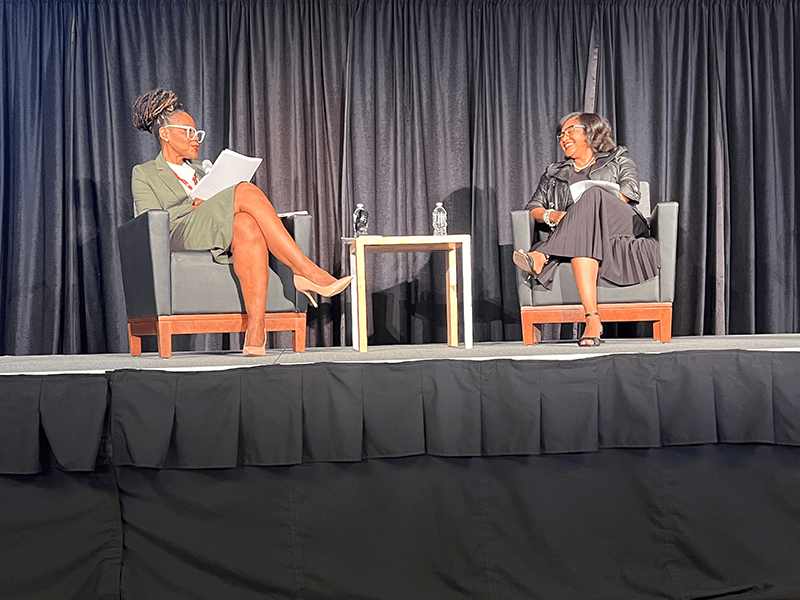
Opening Remix – Dr. Angela Chapman (CCS Superintendent) and Dr. Rotunda Floyd-Cooper (Wallace Foundation Vice President of Education Leadership)
The Ohio State University College of Education and Human Ecology welcomed over 300 educational leaders from across Ohio and beyond for the 2026 Institute on Leading for Student Success, held June 8–9 on Ohio State’s campus. The annual institute, developed in partnership with Columbus City Schools (CCS) and supported through the Wallace Foundation’s Equity-Centered Principal Pipeline Initiative, focused on strengthening leadership practices that promote positive outcomes for all students.
Designed for principals, assistant principals, district administrators, and other educational leaders, the two-day event emphasized the critical role leadership plays in shaping school culture, supporting educators, and advancing student achievement. Participants engaged in professional learning experiences centered on evidence-based strategies, practical leadership tools, and collaborative problem-solving approaches that can be applied directly within schools and the district.
Throughout the institute, attendees explored the concept of student success as both a leadership process and an educational outcome. Sessions highlighted the importance of aligning leadership practices with a district’s vision for student growth while creating environments where every learner can thrive. Organizers structured the event around interactive learning opportunities that encouraged participants to analyze real-world scenarios, engage in strategic planning, and share experiences with peers facing similar challenges.
A central theme of the institute was the development of leadership pipelines that support fairness, continuous improvement, and organizational effectiveness. Participants examined current research, emerging national trends, and promising practices that help educational leaders foster strong school communities and improve student outcomes. The institute also provided opportunities for networking and collaboration, enabling attendees to exchange ideas and build professional relationships that extend beyond the event itself.
The College of Education and Human Ecology has long been recognized for its commitment to preparing educational leaders and advancing innovative approaches to teaching and learning. Through initiatives such as the Leading for Student Success Institute, the college continues to support school leaders as they navigate increasingly complex educational environments while maintaining a focus on student-centered success.
In addition to keynote presentations and workshops, the institute offered opportunities for reflection and discussion about creating growth-minded school cultures, promoting dignity in education, and developing learning environments where all students have opportunities to succeed. These conversations reinforced the importance of leadership that is both responsive to local needs and informed by research and best practices.
As participants concluded the 2026 institute, they left with new insights, practical strategies, and strengthened professional networks. The event reaffirmed a shared commitment among educational leaders to advancing student success through thoughtful leadership, collaboration, and continuous learning—ensuring that schools remain places where every student can achieve their fullest potential.