
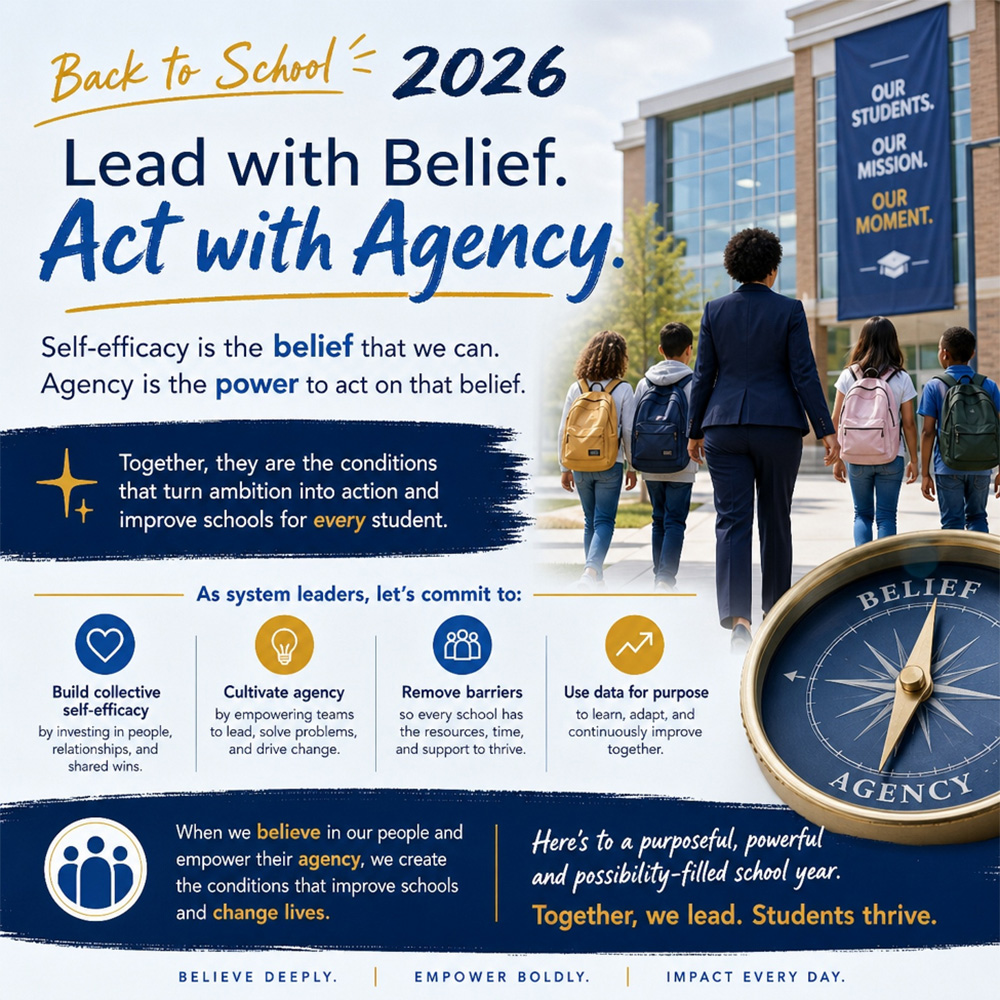
 As a new school year begins, school system leaders are naturally focused on strategic plans, student achievement goals, staffing, budgets, and operational readiness. While each of these priorities matter, one of the most influential factors in school improvement is often less visible: the beliefs educators hold about their ability to make a difference.
Two concepts deserve renewed attention this back-to-school season—self-efficacy and agency.
Self-efficacy is the confidence educators have in their ability to positively influence student learning and organizational outcomes. Agency is the willingness and capacity to act on that belief by making decisions, solving problems, and leading change. Together, they create the conditions for continuous improvement.
When teachers, principals, and district leaders believe their actions matter, they are more likely to embrace challenges, persist through setbacks, collaborate with colleagues, and innovate on behalf of students. Conversely, when people feel that decisions are made for them rather than with them, compliance often replaces commitment, and improvement efforts lose momentum.
School improvement is not simply about implementing another initiative. It is about creating an environment where every educator understands that they have both responsibility and the opportunity to influence student success.
For school system leaders, this requires intentional leadership. Leaders cultivate self-efficacy by celebrating evidence of progress, providing meaningful feedback, investing in professional learning, and ensuring educators have the resources needed to succeed. They strengthen agency by distributing leadership, inviting authentic input into decisions, removing unnecessary barriers, and trusting teams to solve problems closest to students.
The start of the school year offers a powerful opportunity to shape these conditions. Every leadership meeting, professional learning session, classroom visit, and conversation communicates whether educators are viewed as implementers of someone else’s vision or as partners in creating a better future.
High-performing systems recognize that sustainable improvement cannot depend on a few exceptional leaders. It requires building the collective efficacy of teams across every school and department. When educators believe that, together, they can improve outcomes for every learner, that shared belief becomes a powerful driver of organizational success.
As you welcome staff back this year, consider asking a simple but profound question: What conditions are we creating that help every educator believe they can make a meaningful difference—and empower them to act on that belief?
The answer may shape far more than the opening weeks of school. It may determine whether your improvement efforts become another annual initiative or evolve into a lasting culture where confidence, ownership, and shared leadership drive better outcomes for every student.
This school year, let your greatest investment be not only in new strategies, but in strengthening the efficacy and agency of the people who bring those strategies to life every day.